A chorus of economists and pundits—some of whom I actually respect—is currently up in arms over the fallout from the December 18th European Council marathon.
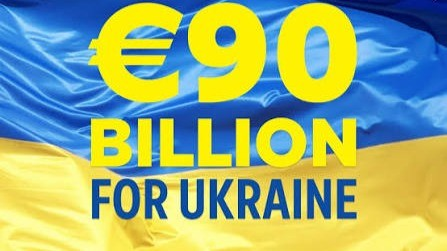
The original plan, pushed by the Commission and Merz’s Germany, was a masterpiece of "creative accounting": pillaging frozen Russian assets held by Euroclear to keep Ukraine’s economy (and military) on life support through 2026/27. That plan died on the vine. Instead, as the sun rose on December 19th, we found out the choice had fallen on a €90 billion loan (https://www.consilium.europa.eu/en/press/press-releases/2025/12/19/european-council-18-december-2025-ukraine/) funded by the "EU24" (the coalition of the willing, minus the holdouts) through the issuance of common debt.
This is the exact same playbook used to bankroll that bureaucratic vanity project known as the Green Deal, whose financing vehicle NextGenEU ([https://commission.europa.eu/strategy-and-policy/priorities-2019-2024/european-green-deal/finance-and-green-deal_en#:~:text=Documents-,Investing%20in%20a%20green%20future,the%20issuance%20of%20green%20bonds](https://commission.europa.eu/strategy-and-policy/priorities-2019-2024/european-green-deal/finance-and-green-deal_en#:~:text=Documents-,Investing%20in%20a%20green%20future,the%20issuance%20of%20green%20bonds).) aims to incinerate €1 trillion, nearly half of it through common debt—€250 billion of which has already been funneled to member states, Italy uber alles.
Listen to the podcast "Dalla Realtà al Mercato, dal Mercato alla Realtà"
Today, many are screaming "free rider," accusing France and Italy of hiding behind Germany’s fiscal skirt to secure low interest rates for Ukraine. They’ve added a garnish of moral grandstanding, suggesting that anyone reluctant to "creatively" seize Russian assets must be a Kremlin sympathizer.
While I’ll grant that some in Europe are indeed soft on Moscow, the outrage over the financing mechanism is pure theater.
If the EU considers the suicidal rush toward renewables and EVs "strategic"—a move that spiked energy costs, gutted German and Italian manufacturing ([https://rivisteweb.it/doi/10.1434/118211](https://rivisteweb.it/doi/10.1434/118211)), and handed our geostrategic neck to China—then why should Ukraine be treated any differently?
The defense of the Eastern Flank is infinitely more "existential" than green fantasies. Ukraine is the de facto extension of our border. The deal is simple: they provide the blood, we provide the cash.
It is a special kind of irony that the economically regressive measures of the Green Deal ([https://twitter.com/degiorgiod/status/1458495166252298251?t=IYJ_nEGKDqEAikXk8DMzcA&s=19](https://twitter.com/degiorgiod/status/1458495166252298251?t=IYJ_nEGKDqEAikXk8DMzcA&s=19)) were waved through without a whisper. We are happy to burn hundreds of billions for decades on "high-impact" transitions that are proving to be either incomplete ([https://twitter.com/degiorgiod/status/1998866909601919439?t=bnrCH5oU5WqjHM3JgxHbbA&s=19](https://twitter.com/degiorgiod/status/1998866909601919439?t=bnrCH5oU5WqjHM3JgxHbbA&s=19)) or outright industrial sabotage (the internal combustion engine ban being the prime example). Yet, when it comes to the only genuine existential threat—the defense of Ukraine—suddenly we need "legally sound" gymnastics to find the money.
Is the goal to show Moscow we can "hurt" them? We tried that with sanctions, and four years later, the war grinds on comfortably.
The weaponization of sanctions—unleashed at the dawn of Putin's wretched invasion on February 24, 2022, under the direction of the U.S. administration—exposed its fundamental flaw from day one. It was a PR stunt (https://twitter.com/degiorgiod/status/1538618549182337028?t=_otuJGmkNQLY-f01xBw6pQ&s=19) designed to convince the Western public that we could extinguish a war of aggression without firing a single shot. The narrative was simple: "financially punish" the aggressor, and the invasion would spontaneously collapse for lack of funds.
Instead, this approach has backfired spectacularly. On one hand, it created a "bubble of abstraction" for Western and European audiences, insulating them from the raw tragedy of the conflict (https://twitter.com/degiorgiod/status/1741453907870581070?t=ZbEFniroC5swvR5B51800Q&s=19) and the existential threat looming over Eastern Europe. On the other, it only emboldened the Russian war machine to double down "at any cost." This is the predictable outcome of autocratic logic: where the ultimate goal is centralized empire, the "budget constraints" that govern democracies simply do not apply (https://twitter.com/degiorgiod/status/1572479305799856129?t=TJdaxxbcGznbrUjUrplT0w&s=19).
- Treating Ukraine defence as European defence
- Making public opinions aware of where their taxes are spent directly linking fiscal imposition to funded goal (security)
Unless we do this, applying the right economic theories to the wrong geopolitical realities produces nothing but absurdity.
This latest debate is no exception.
_________________________________________________________
Listen to the Podcast "Dalla Realtà al Mercato, dal Mercato alla Realtà"