(The following article was originally posted on LinkedIn on December 31, 2025. You can find it here: https://www.linkedin.com/pulse/terra-incognita-fragility-european-natural-gas-market-de-giorgio-doz8f/?trackingId=6LYLJ6BJTnOPo7u%2Bt2Xx8A%3D%3D)
By late December 2025, the narrative of a US supply deluge providing a safety net for European energy security has been fundamentally challenged. Despite prevailing optimism from many observers, the European natural gas market is entering what experts describe as terra incognita, characterized by depleting stocks, price parity with Asian markets, and the unintended consequences of an aggressive transition to renewable energy.
The Illusion of US Abundance
Throughout 2025, market commentators frequently misinterpreted the tightening US LNG FOB-TTF/NWE spread as a sign of forthcoming supply abundance. However, this perspective ignored the internal tensions within the US domestic market.
As early as September 2021, concerns were raised regarding the political sustainability of exporting approximately 15% of US natural gas production while domestic households and industries faced potential losses in purchasing power.
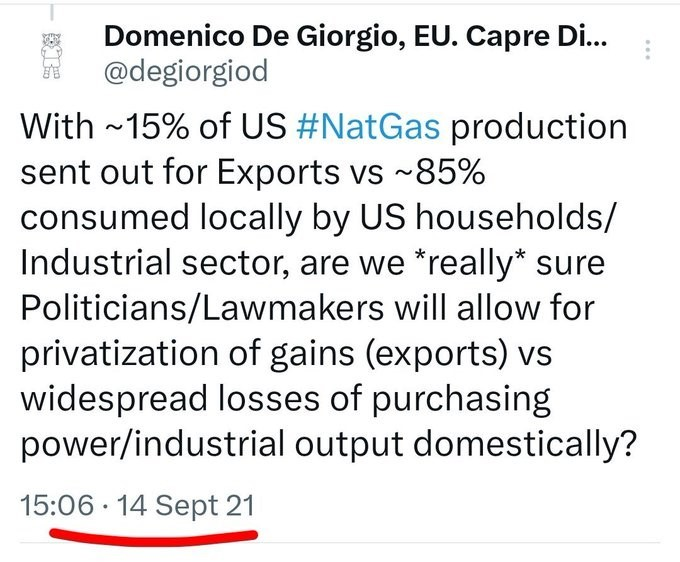
By December 2025, this tension reached a boiling point as the US Lower 48 states faced winter rigors, forcing domestic prices to confront weather-elastic residential demand alongside price-inelastic external LNG demand.
Price Parity and Global Competition
The myth of the supply deluge was further dispelled by the pricing shifts observed in late December 2025. As the F6 contract went off the board, the Title Transfer Facility (TTF) — the European benchmark — instantly lost its discount to the Japan Korea Marker (JKM). Prompt prices firmed by approximately €27/MWh,
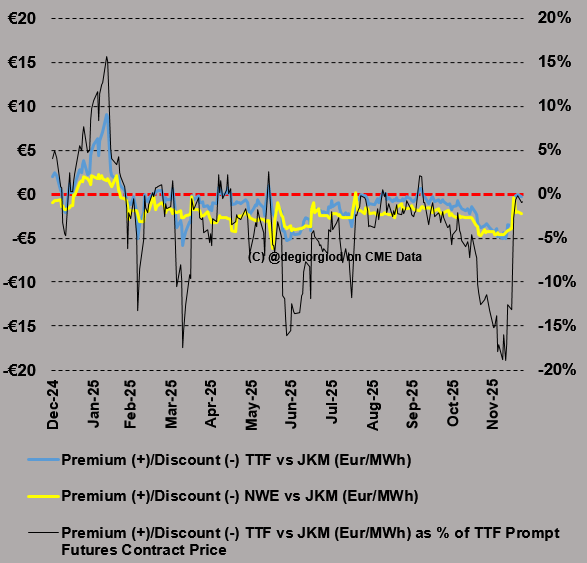
All of this as trailing rolling contracts returned to a near-perfect overlap as CAL26 strips stabilized.
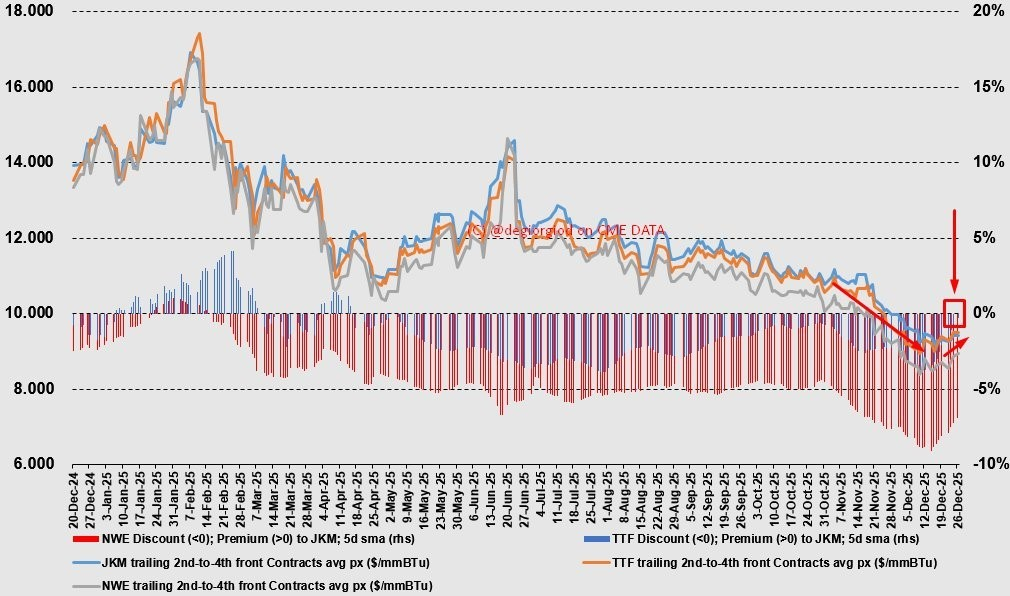
This convergence indicates that Europe is no longer benefiting from a regional surplus and must compete directly with Asian demand for every molecule of LNG.
The Critical State of European Storage
The physical reality of European energy security is perhaps most clearly reflected in storage levels. As of December 29, 2025, EU natural gas stocks are described as all but ample. Data indicates a significant departure from historical norms.
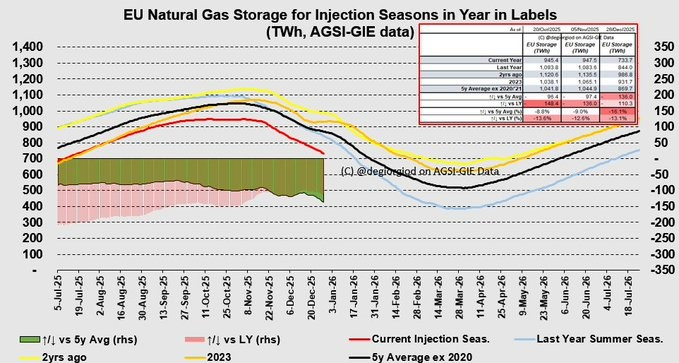
The 2025/26 winter season is projected to end with the second-lowest stocks in ten years, estimated at just 209.8 TWh
Drawdown Rates. While the current winter drawdown is recorded at -22.4% of maximum capacity, the end-of-draw (EOD) storage levels are expected to be dangerously thin compared to previous years.

National Disparities
Germany, a central pillar of the EU economy, reports natural gas stocks 58 TWh lower than the previous year, despite facing industrial annihilation and extremist political backlash.
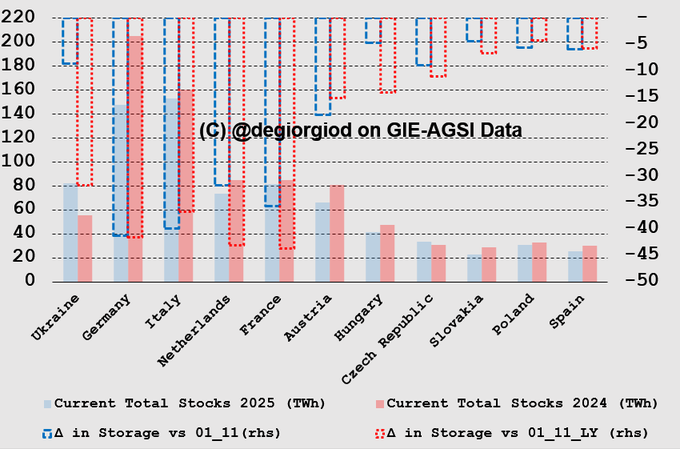
The Renewable Energy Paradox is the most significant driver of this storage depletion as the inherent volatility of Renewable Energy Sources (RES) wreaks havoc to system stability and affordability (see:
 Domenicantonio De Giorgio
https://www.rivistaenergia.it/2025/10/inverno-dunkelflaute/ ).
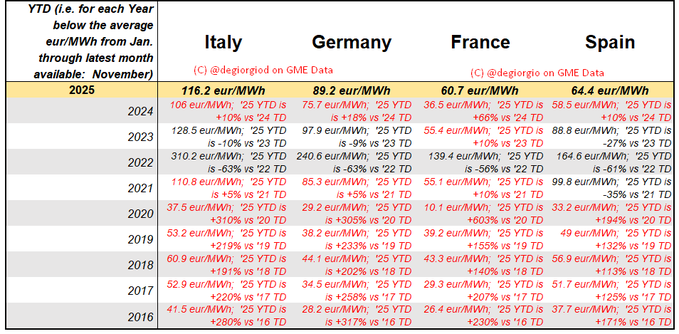
Wholesale power prices continue to soar across the continent (see below for 2025 average prices through November). This trend is driven by the intermittency costs of an increasing share of domestic net power generation in key European markets—costs that have become not only visible but detrimental to overall power affordability for households, while simultaneously undermining industrial and manufacturing competitiveness.
While the RES-fundamentalist narrative promises a 100% renewable grid, the reality of the 2024-2025 winter suggests otherwise. Non-dispatchable renewables have created power generation troughs during periods of uncooperative weather — often referred to as Dunkelflaute. To compensate for these troughs, an ever-smaller fleet of natural gas and coal-fired plants must work with immense effort to maintain grid stability. This reliance on gas as a backstop for intermittent renewables explains why stocks continue to deplete even when international supplies are theoretically ample.
My latest paper "Too Much of a Good Thing? The Case of Renewable Energy in Europe. An Analysis of Winter 2024-2025" delves with abundant evidence precisely on this thorny aspect (see:
 Domenicantonio De Giorgio
https://rivisteweb.it/doi/10.1434/118211).
Conclusion: New Year, Old Problems
The convergence of these factors — US domestic price pressures, the disappearance of the TTF discount to JKM, and the systemic strain caused by intermittent renewables — paints a sobering picture for the start of 2026. Europe remains precariously dependent on favorable weather and a volatile global market, standing on a terra incognita where past experiences may no longer provide a reliable map for the future.
_________________________________________________________
Listen to the Podcast "Dalla Realtà al Mercato, dal Mercato alla Realtà"