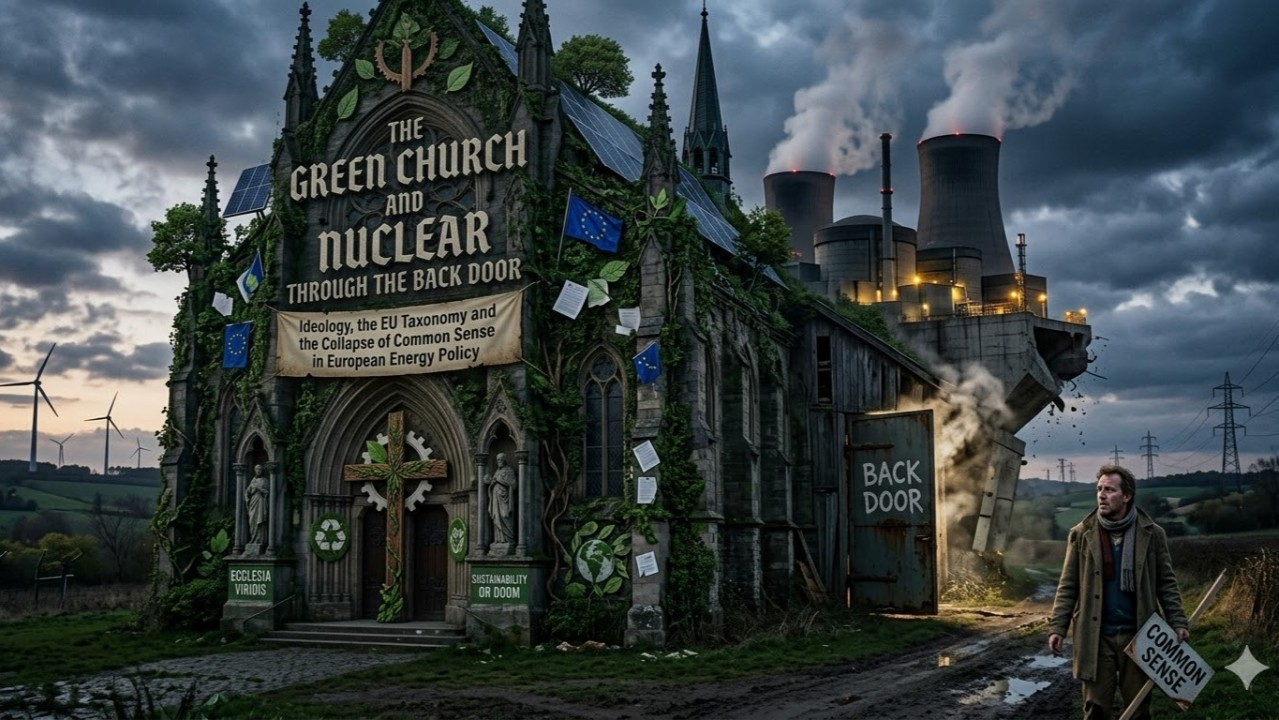
On 10 March 2026, at the IAEA Nuclear Energy Summit in Paris, Ursula von der Leyen delivered her public confession: reducing Europe's nuclear capacity had been "a strategic mistake." Ten years of green catechism, of fideistic technocracy, of sustainable finance as liturgy — and now this. The problem is not the repentance itself. The problem is that the regulatory apparatus built during the years of green fundamentalism — the EU Taxonomy, the EU Green Bond Standard, the SFDR — remains intact and fully operational, enshrining in law a worldview that its very architect now disavows in front of Reuters and Bloomberg microphones. This essay is an indictment. Not the first one: it is the continuation of a position held consistently for years, when it was uncomfortable and minority. Today, on the wave of the Iranian crisis and gas prices spiking again, rediscovering pragmatism is easy. But the damage is done — and its roots run deeper than any Parisian summit can heal.
I. THE DAMASCUS CONVERSION OF A FORMER MINISTER OF NUCLEAR DISARMAMENT
Von der Leyen declared in Paris what anyone who has followed energy policy with intellectual honesty has known for years: that reducing nuclear's share of European electricity generation from one-third in the 1990s to just 15% today was not the neutral outcome of market forces, but a "choice" — her word — politically directed and ideologically motivated. A choice that left Europe "completely dependent on costly and volatile fossil fuel imports," placing it in a "structural disadvantage" relative to other regions. This was reported across Reuters, Bloomberg, World Nuclear News, and France24.
So far, the diagnosis is correct. The problem is the biographer: von der Leyen herself was a minister in the Merkel government when, in 2011, riding a wave of post-Fukushima emotion — an accident that caused zero radiation-related deaths in Germany — the decisive acceleration was given to the Atomausstieg, the progressive shutdown of Germany's nuclear fleet. That fleet was world-class: safe, mature, and fully decarbonised. It was demolished with ideological pickaxes. As I argued in March 2023 in response to Jean-Michel Glachant (former head of the FSR) and the IEA: "An ideology detached from physics and financial viability can produce nothing but disasters." Three years later, the President of the European Commission repeats it in front of the world's cameras. The irony would be comic if the cost were not tragic.
"In 1990, one-third of Europe's electricity came from nuclear. Today it is only close to 15%. This reduction in the share of nuclear was a choice. And, in hindsight, it was a strategic mistake." — Ursula von der Leyen, IAEA Nuclear Energy Summit, Paris, 10 March 2026
German Chancellor Friedrich Merz, CDU like von der Leyen, used identical language in January 2026: "a massive strategic mistake." Yet Germany was conspicuously absent from the forty nations present at the IAEA Paris summit. An eloquent absence. The German Environment Minister, Carsten Schneider, dismissed von der Leyen's position as a "retrospective strategy," reasserting the supremacy of wind and solar. The green liturgy continues, even as the temple burns.
II. THE TAXONOMY AS CATECHISM: ANATOMY OF A FIDEISTIC APPARATUS
To grasp the depth of the problem, one must go to the root: the EU Taxonomy for Sustainable Finance (Regulation EU 2020/852). Born with the laudable ambition of scientifically defining what is "green," it has become — in the way it was built, applied and defended — something very different: a classification system with the dogmatic rigidity of a catechism.
The founding principle is, in appearance, reasonable: create a common language to orient capital towards environmentally sustainable activities. In practice, however, it revealed a theological drift: the Taxonomy's technical committee (TEG, later the Platform on Sustainable Finance) operated with the absolute certainty of those who possess revealed truth. Anyone outside the canon — nuclear and gas first — was simply heretical, regardless of what physics, the IPCC, or the International Energy Agency had to say.
Nuclear power — the par excellence low-carbon source, with lifecycle emissions comparable to wind and lower than solar — remained excluded from the "green" category of the first Climate Delegated Act (January 2022). Not for scientific reasons — the IPCC explicitly includes it among decarbonisation technologies — but for reasons of political balance within the EU, with Austria, Germany and Luxembourg playing the role of conservative cardinals in a conclave where physics had no right to vote.
III. NUCLEAR THROUGH THE BACK DOOR: "TRANSITION" AS PENANCE
On 2 February 2022 — eight days before the Russian invasion of Ukraine, while tanks were massing at the border — the European Commission adopted the Complementary Climate Delegated Act (CCDA). For the first time, nuclear and gas were included in the Taxonomy. Europe hurried to present the measure as an act of pragmatism. It was, in reality, a half-measure dressed as compromise.
The distinction is crucial, and deliberately obscured in the public debate: nuclear and gas do not enter the Taxonomy as "green activities," but as "transition activities" under Article 10(2) of the Taxonomy Regulation. That is: tolerated temporarily, not celebrated. Bridge fuels, in the Anglo-Saxon terminology — to be crossed quickly on the way to the renewable paradise. Nuclear power — which has been generating zero-CO₂ electricity for over sixty years — is treated as a roadside stop rather than a destination.
The conditions imposed on nuclear for Taxonomy alignment form a bureaucratic labyrinth: adoption of Accident-Tolerant Fuels (ATF) by 2025, detailed waste disposal planning with regulatory approval by 2050, full compliance with Euratom directives. For gas, the qualification expires in 2035 and requires a mandatory transition to low-carbon gases. Neither source may carry the green label. They are tolerated. Provisionally.
This is not pragmatism: it is the management of heresy. A conditional dispensation is granted to the heretic — nuclear power — without ever acknowledging that the dogma was wrong. The conversion is apparent. The underlying regulatory architecture remains intact, along with all its consequences for capital markets.
IV. GREEN BONDS AS TOMBSTONES OF COMMON SENSE
This is where the damage becomes structural, irreversible in the short term, and devastating for the prospects of financing European nuclear. Green bonds are the cardinal instrument through which private capital is directed towards the energy transition. The global green bond market has surpassed one trillion dollars in annual issuance. In Europe, the most ambitious framework is the EU Green Bond Standard (EuGBS), introduced by Regulation EU 2023/2631, in force from 20 December 2023 and applicable from 21 December 2024.
The EuGBS principle is simple and lethal for nuclear: 100% of the proceeds of any bond carrying the "European Green Bond" label must be invested in Taxonomy-aligned activities — and aligned means aligned, not merely eligible. Since nuclear falls within the Taxonomy only as a transition activity (with all the restrictive conditions described above), the eligibility perimeter for a EuGB incorporating nuclear is extremely narrow, complex, and effectively discouraging for issuers.
But there is more. The private green bond market — dominated by the ICMA Green Bond Principles and the Climate Bonds Initiative (CBI) standards — is even more restrictive. The CBI explicitly excludes unabated fossil gas from its Climate Bonds Taxonomy and maintains critical positions on nuclear inclusion. Its Green Bond Database, widely used by institutional investors to build ESG indices, excludes projects tied to unabated fossil gas. The practical result: an operator seeking to raise green bond financing for a new nuclear plant in Europe will encounter a regulatory jungle, a hostile ESG rating system, and a universe of institutional investors who have embedded sectoral exclusions into their investment policies — exclusions that are extremely difficult to remove in the short term.
This is not mere bureaucracy: it is a self-fulfilling prophecy. If you cannot finance nuclear with green capital — and green capital has become the primary source of financing for energy infrastructure — then nuclear does not get built. This was the underlying logic of the fideistic apparatus: it was never necessary to legally prohibit nuclear. It was sufficient to render it financially unreachable through regulatory engineering. As I wrote in February 2022, commenting on the Green Deal: these are "penitential policies" disguised as science.
The final paradox is that this architecture — built to prevent greenwashing — risks producing the most dangerous greenwashing of all: the systemic kind, in which billions of euros flow towards intermittent renewables that cannot sustain the grid without the dispatchable sources that the same architecture excludes or discourages.
V. THE ENERGIEWENDE AS A MONUMENT TO IDEOLOGY: "MAKE POVERTY GREAT AGAIN"
Germany is the definitive case study — and the most instructive, because it is the country that has carried this logic to its extreme consequences with greater consistency than any other. The Energiewende — Germany's energy transition — deliberately dismantled a world-class nuclear fleet, built tens of gigawatts of wind and solar, and ended up burning more coal than Italy, paying some of Europe's highest industrial electricity prices, and depending on Russian gas for baseload power.
In 2010, according to Fraunhofer ISE data, German nuclear plants generated approximately 140 TWh — nearly a quarter of total output. By 2024, the last reactor had been shut down and in many cases physically demolished, rendering the process de facto irreversible. Between 2019 and 2025, German net electricity generation collapsed by 28%. Industrial electricity prices — a critical factor for manufacturing competitiveness — more than doubled relative to the 2010s average. As I ironised in 2023 when commenting on this process: "Make Poverty Great Again." It was not a witticism: it was an accurate description of an industrial policy choice.
All of this while Texas — with a less "ideologically correct" but far more pragmatic energy mix — added renewables onto an expanding system, reached 30% wind and solar in its electricity mix without destabilising the grid, and recorded price increases of around 12% over a decade. The difference is not geographical: it is methodological. It is the difference between adding and subtracting. Those who add obtain resilience; those who subtract obtain vulnerability.
VI. TEXAS AS ANTIDOTE: PRAGMATISM AGAINST IDEOLOGY
The comparison with Texas — analysed in detail in my article "Texas: a Model for Europe's Energy Transition" (Rivista Energia, November 2025) — is not nostalgia for fossil fuels, nor a denial of climate change. It is, on the contrary, the empirical demonstration that the energy transition works when it is guided by physics and economics, not ideology.
Texas has integrated 30% variable renewables onto a grid anchored by gas, coal and — in growing measure — nuclear (Comanche Peak and South Texas Project are among the most efficient plants in the United States). When renewables are not producing — due to calm winds or overcast skies — the grid holds because a dispatchable base exists. The February 2021 blackouts were caused by failure to winterise infrastructure, not by an excess of renewables: and Texas responded with concrete infrastructure investment, not with climate liturgy.
Europe did exactly the opposite: it removed baseload sources before adequate alternatives were in place, created systemic fragility, then tried to plug the gaps with imported LNG at world market prices, Russian gas, and — when that was not enough — coal. As I analyse in my academic study "Too Much of a Good Thing? The Case of Renewable Energy in Europe. An Analysis of Winter 2024-2025" (Mercato, Concorrenza, Regole, 2025), that winter saw gas storage levels fall 66% despite mild temperatures and depressed industrial demand. This is not an accidental result: it is the foreseeable — and foreseen — consequence of an energy architecture built on ideological foundations.
The Texan lesson is elementary in its simplicity: energy is added, not subtracted. Renewables are integrated onto a functioning system; they do not replace sources that still play an essential role. This is the difference between transition and demolition.
VII. THE MISSED PROPHECY AND EUROPE'S SHORT MEMORY
I have been consistely documenting this trajectory for well ovr five years now. In February 2022, while Europe was still debating whether to include nuclear and gas in the Taxonomy, I denounced the Green Deal as a "flawed framework" and European energy policies as "penitential," driven by guilt and by ideologies that privileged abstraction over physics. In September 2022, I warned that Europe was "selling its soul" to unstable global supply chains for alternative energies, without the security of a nuclear base.
In January 2026, I cited the egalitarian mindset of the 2010–2020 decade as fertile ground for technocratic apparatuses such as the Green Deal. In February 2026, I reiterated my long-standing opposition to the financial absurdities linked to ESG criteria, predicting failures in the overestimation of the pace of energy transition — admissions since made public by industrial leaders including the CEO of Stellantis. And on 11 February, I flagged the infiltration of these criteria even into the equity indices of the Vatican Bank: a fact I described as "disturbing," testifying to the capillary extension of a normative-financial apparatus built on faith, not evidence.
None of this was unforeseeable. It was, in fact, widely foreseen. Europe's problem was not a lack of critical analysis: it was a lack of political will to listen, crushed under the weight of a green orthodoxy that had colonised institutions, media, rating agencies and — crucially — financial markets through ESG finance.
VIII. FINANCE AS THE ARMED WING OF IDEOLOGY
One cannot understand the depth of the problem without analysing the role of ESG finance. When environmental, social and governance criteria began infiltrating global equity indices — from MSCI to Bloomberg Barclays, to the Vatican Bank's own indices — the ideological mechanism acquired systemic reach. It was no longer merely a question of energy policy: it had become a question of access to capital.
A nuclear company that scores low on ESG because it manages radioactive waste faces a higher cost of capital, exclusion from pension funds, from impact finance, from green bonds. This is the real "tax" on nuclear power that no legislator ever explicitly voted for, but which has been imposed through financial architecture. It is more effective than any formal prohibition, because it acts on cash flows rather than on regulations.
The EU Green Bond Standard, in its current form, consolidates this structure. By tying 100% of bond proceeds to Taxonomy alignment and keeping nuclear in a transition category burdened by near-prohibitive conditions, the EuGBS codifies into Europe's financial architecture the value hierarchy of green fundamentalism. This is not accidental: it is the result of years of systematic advocacy by organisations such as the Climate Bonds Initiative, Greenpeace and a galaxy of NGOs that enjoyed privileged access to the European Commission's technical working groups during the drafting of the regulations.
Now von der Leyen promises 200 million euros in guarantees for innovative nuclear technologies, financed through the ETS system. A symbolic figure, commendable in direction, but one that does not touch the underlying architecture. EDF needs tens of billions for new EPRs. The United Kingdom will spend 30 billion on Hinkley Point C alone. Two hundred million euros in European guarantees do not change the nuclear financing equation as long as the Green Bond Standard remains as presently constructed.
IX. THE BELATED NUCLEAR REARMAMENT AND STRUCTURAL HYPOCRISY
Von der Leyen's conversion is not sincere in the full sense — not because she is personally dishonest, but because it is structurally incomplete. Acknowledging the error in words without modifying the regulatory architectures that produced it is a sophisticated form of institutional hypocrisy. It is repentance without restitution: the sin is confessed, but the stolen goods are not returned.
The stolen goods, in this case, are time. New nuclear reactors require between ten and fifteen years to build under optimal conditions. Germany has physically demolished its plants, making any reversal in the short term impossible. Chancellor Merz speaks of a "massive mistake" but has not launched a new nuclear programme. Germany's absence from the IAEA summit is eloquent: one can acknowledge the error without intending to correct course.
Meanwhile, the crisis with Iran — which has sent oil prices soaring and reactivated the spectre of the 2022 energy shock — has simply accelerated the narrative, not changed the regulatory substance. The Green Bonds remain as they are. The Taxonomy remains as it is. Nuclear remains "transitional." Gas retains its 2035 deadline. The architecture of faith is intact. Only the sermon has changed.
CONCLUSION: PRAGMATISM OR DECLINE
For decades, Europe chose to govern energy complexity through ideological simplification. It built a regulatory apparatus — the Taxonomy, the Green Bond Standard, the SFDR — that reflects a religious value hierarchy, not a scientific one: renewables are sacred, nuclear is tolerated as a penitent, gas is a conditional heresy, coal is the Evil One. This architecture has generated systemic vulnerabilities that every geopolitical crisis — Russia in 2022, Iran in 2026 — has rendered painfully visible.
The lesson is not that renewables are wrong: it is that their integration requires a robust dispatchable system, and nuclear power — stable, low-carbon, energy-dense — is the most natural source for this role. Texas understood this through pragmatism. Europe will have to understand it through necessity, with the aggravated luxury of having dismantled the infrastructure in the meantime.
Acknowledging the error, as von der Leyen did in Paris, is necessary but not sufficient. What is needed is a structural reform of Europe's sustainable finance regulatory architecture: nuclear must enter the EU Green Bond Standard without prohibitive conditions; the Taxonomy must recognise it as a fully green activity, in light of what the IPCC and the IEA have been saying for years; the ESG criteria embedded in financial indices must be rewritten on the basis of scientific evidence, not ideological lobbying.
Until that happens, von der Leyen's conversion will remain what it is: a speech delivered in Paris before television cameras, while in Brussels the apparatus of faith continues to turn, undisturbed.
Common sense is not recovered with a summit. It is recovered by dismantling, piece by piece, the architecture that buried it.